
Ivan Ilych's life had been most simple and most ordinary and therefore most terrible.
The Death of Ivan Ilyich, one of the great memento mori texts of all time, and also the only thing by Tolstoy most people get around to reading (it's mercifully short), is linked above. The free translation isn't great, but hey, you get what you pay for.
Tuesday, March 31, 2009


Wednesday, March 25, 2009
C'mon, what do you think a tower is supposed to symbolize?
http://news.bbc.co.uk/newsbeat/hi/newsbeat/newsid_7961000/7961224.stm
Now THAT is an Axis Mundi anyone can get behind. Or in front of. Or beneath. Or if you're feeling particularly creative. . .
Little does the budding artist know, he is carrying on a noble, centuries-old British tradition. Though that phallus is a mere 36 feet.
Comicality aside, the phallus as an Axis Mundi is not a particularly new idea. See: the title of this post.
Now THAT is an Axis Mundi anyone can get behind. Or in front of. Or beneath. Or if you're feeling particularly creative. . .
Little does the budding artist know, he is carrying on a noble, centuries-old British tradition. Though that phallus is a mere 36 feet.
Comicality aside, the phallus as an Axis Mundi is not a particularly new idea. See: the title of this post.
Tuesday, March 24, 2009
Tuesdays With Memento Mori: Vidiotic Interlude:

http://hcsoftware.sourceforge.net/passage/
Passage, linked above, is a most unusual game. I insist you play it before reading this because, well, text doesn't do a very good job at describing the sensation of gameplay. It only takes a few minutes.
Now, in Passage you begin with your avatar at the far left of the screen. Immediately at the beginning of the game you see a female companion for your avatar, who you can run to or ignore. As you walk to the right your score goes up, and if you find some treasure chests your score goes up more.
The more you walk to your right, the more the seasons change. The landscape gets greyer and wintrier as your avatar (and the female if you got her) gets older. Eventually you die. The end.
There's no goal, there's no end boss. If you get the companion you can't access the treasure chests, but it doesn't matter, your score is totally irrelevant, a large bunch of numbers. You always die in the end. Thus the reason for posting this on Tuesday.
Tuesday, March 17, 2009
Tuesdays with Memento Mori: Musical Interlude
Let's try something a little different today. I've embedded a song in the post, so you can listen to it right here. This song, "Losing Haringey" by The Clientele, embodies nostalgia and the inexorability of change.

Losing Haringey - The Clientele
Lyrics worth noting:
[Thanks to SongMeanings.net for realizing that proper punctuation and lyrics sites do not have to be mutually exclusive]
This song, unlike the rest of the album 'Strange Geometry' (of which Losing Haringey is the penultimate track), is chanted more than sung; even though 'there is no way to go except back,' the voice advances inevitably at the same pace. His continuing even pitch and pace separates him from the real world, filled with life, which he is describing. It is of course when he heads somewhere he has never been before that he is transmuted into a situation of decades past.
Life floats past the speaker until he falls into a situation in which that is natural. The revelation of this photograph and the days of his youth and happiness at first is 'inconsolably sad.' Immense weariness holds him down as his past traps him.
But at last he walks away; by seeing the past exactly as it was, he is revitalized in his own life.
---
On last week's subject:
The city of Seleucia/Ctesiphon was the capital of Persia for over 700 years. Alexander's general Seleucus founded it; it outlasted Greek rule, and was the seat of both the Parthians and Sassanids in their long reigns. For a time it was the largest city in the world.
But like most cities in the Fertile Crescent, its river was its lifeblood.
And over the centuries, something so immutable as the River Tigris shifted, and Ctesiphon was left high and dry. And the largest city in the world drained away. The Arabs came, saw, and conquered, and founded a new city along the river's new course: Baghdad.
Only one structure in Ctesiphon survives today. The rest is gone, or buried in sand:
 Nothing beside remains.
Memento mori.
Losing Haringey - The Clientele
Lyrics worth noting:
It seemed unlikely that anything could hold much longer. The only question left to ask was what would happen after everything familiar collapsed, but for now the sun was stretched between me and that moment.
[...]
I held my head in my hands, feeling like shit, but a sudden breeze escaped from the terraces and for a moment I lost my thoughts in its unexpected coolness. I looked up and I realised I was sitting in a photograph.
I remembered clearly: this photograph was taken by my mother in 1982, outside our front garden in Hampshire. It was slightly underexposed. I was still sitting on the bench, but the colours and the planes of the road and horizon had become the photo. If I looked hard, I could see the lines of the window ledge in the original photograph were now composed by a tree branch and the silhouetted edge of a grass verge. The sheen of the flash on the window was replicated by bonfire smoke drifting infinitesimally slowly from behind a fence. My sister�s face had been dimly visible behind the window, and yes- there were pale stars far off to the west that traced out the lines of a toddler's eyes and mouth.
[...]
Strongest of all was the feeling of 1982-ness: dizzy, illogical, as if none of the intervening disasters and wrong turns had happened yet. I felt guilty, and inconsolably sad. I felt the instinctive tug back - to school, the memory of shopping malls, cooking, driving in my mother�s car. All gone, gone forever.
[Thanks to SongMeanings.net for realizing that proper punctuation and lyrics sites do not have to be mutually exclusive]
This song, unlike the rest of the album 'Strange Geometry' (of which Losing Haringey is the penultimate track), is chanted more than sung; even though 'there is no way to go except back,' the voice advances inevitably at the same pace. His continuing even pitch and pace separates him from the real world, filled with life, which he is describing. It is of course when he heads somewhere he has never been before that he is transmuted into a situation of decades past.
Life floats past the speaker until he falls into a situation in which that is natural. The revelation of this photograph and the days of his youth and happiness at first is 'inconsolably sad.' Immense weariness holds him down as his past traps him.
But at last he walks away; by seeing the past exactly as it was, he is revitalized in his own life.
---
On last week's subject:
The city of Seleucia/Ctesiphon was the capital of Persia for over 700 years. Alexander's general Seleucus founded it; it outlasted Greek rule, and was the seat of both the Parthians and Sassanids in their long reigns. For a time it was the largest city in the world.
But like most cities in the Fertile Crescent, its river was its lifeblood.
And over the centuries, something so immutable as the River Tigris shifted, and Ctesiphon was left high and dry. And the largest city in the world drained away. The Arabs came, saw, and conquered, and founded a new city along the river's new course: Baghdad.
Only one structure in Ctesiphon survives today. The rest is gone, or buried in sand:
 Nothing beside remains.
Memento mori.
Sunday, March 15, 2009
Every Blog Links xkcd Sooner or Later.
Courtesy of xkcd. Click on the picture, or just go to the website, because Blogger doesn't love big pictures.
 Not only a perfect twist ending, but a gradual drawing out of the highly improbable and eventually the whimsical from the sheer mundanity of electricity generation.
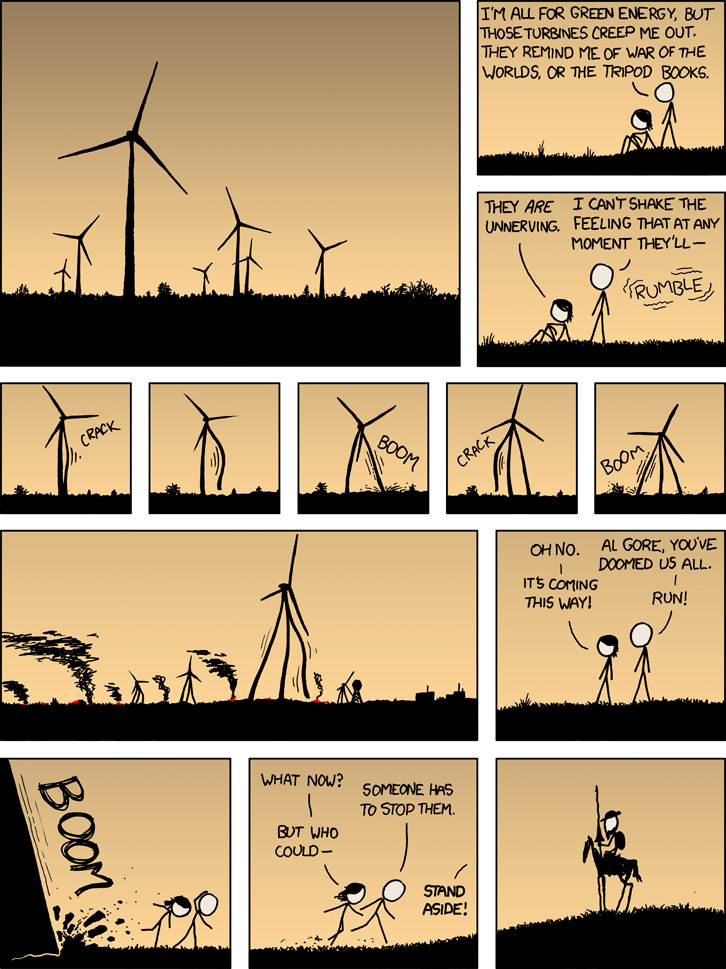 Not only a perfect twist ending, but a gradual drawing out of the highly improbable and eventually the whimsical from the sheer mundanity of electricity generation.
Tuesday, March 10, 2009
Tuesdays with Memento Mori: Ozymandias
In honor of Watchmen, which is the most nostalgic film ever to score a $50m+ opening, you should read this poem, which you probably have not read.
Everybody knows Percy Bysshe Shelley's famous "Ozymandias" poem, which (not surprisingly) is one of my four or five favorite lyric poems.
Many people know he wrote the poem in competition with his friend, a fellow named Horace Smith. They both took Ozymandias as their subject and title. Shelley won, not least because his is better, but because it is remembered. His work and name endures in many minds; Horace Smith is a much farther cry from being a household name.
Everybody knows Percy Bysshe Shelley's famous "Ozymandias" poem, which (not surprisingly) is one of my four or five favorite lyric poems.
Many people know he wrote the poem in competition with his friend, a fellow named Horace Smith. They both took Ozymandias as their subject and title. Shelley won, not least because his is better, but because it is remembered. His work and name endures in many minds; Horace Smith is a much farther cry from being a household name.
Ozymandias
Horace Smith
Horace Smith
In Egypt's sandy silence, all alone,
Stands a gigantic Leg, which far off throws
The only shadow that the Desert knows:
"I am great OZYMANDIAS," saith the stone,
"The King of Kings; this mighty City shows
"The wonders of my hand." The City's gone,
Nought but the Leg remaining to disclose
The site of this forgotten Babylon.
We wonder, and some Hunter may express
Wonder like ours, when thro' the wilderness
Where London stood, holding the Wolf in chace,
He meets some fragments huge, and stops to guess
What powerful but unrecorded race
Once dwelt in that annihilated place.
---
Always remember that, like Ozymandias (whether in Egypt or Watchmen), all things shall come to ruin, and the glory of the world shall pass.
Stands a gigantic Leg, which far off throws
The only shadow that the Desert knows:
"I am great OZYMANDIAS," saith the stone,
"The King of Kings; this mighty City shows
"The wonders of my hand." The City's gone,
Nought but the Leg remaining to disclose
The site of this forgotten Babylon.
We wonder, and some Hunter may express
Wonder like ours, when thro' the wilderness
Where London stood, holding the Wolf in chace,
He meets some fragments huge, and stops to guess
What powerful but unrecorded race
Once dwelt in that annihilated place.
---
Always remember that, like Ozymandias (whether in Egypt or Watchmen), all things shall come to ruin, and the glory of the world shall pass.
Monday, March 9, 2009
Axis Monday: Castles in the Sky
Towers or spires are the most common manmade form of the axis mundi. However, in certain cases a castle or palace may take on the same characteristic.
Now it is obvious that certain castles or palaces--Versailles is the most apparent--hold some of the same traits as the axis mundi, just as the U.S. Capitol does today. But these are political axes mundorum. They do indeed represent the center of all things for a nation or culture, upon which all converges, but solely in that political sense. These structures, or similar ones, are also metonymous for the government itself (e.g. 'The White House today released a statement that..." and similar ubiquities).
But these two castles do not bridge the mundane and the symbolic in that particular way. These are more naturalistic axes. They form central poles less because of their history or importance than their position. Both are situated halfway between Earth and Sky.
Now it is obvious that certain castles or palaces--Versailles is the most apparent--hold some of the same traits as the axis mundi, just as the U.S. Capitol does today. But these are political axes mundorum. They do indeed represent the center of all things for a nation or culture, upon which all converges, but solely in that political sense. These structures, or similar ones, are also metonymous for the government itself (e.g. 'The White House today released a statement that..." and similar ubiquities).
But these two castles do not bridge the mundane and the symbolic in that particular way. These are more naturalistic axes. They form central poles less because of their history or importance than their position. Both are situated halfway between Earth and Sky.
Swallow's Nest
Swallow's Nest has no political importance. It is not particularly large (65 ft x 33 ft), nor particularly old (1911). But it is nevertheless spectacular. It is one of the most popular tourist attractions in the Crimea. And it forms a triple bridge between Earth, Sea, and Sky:

Much of Swallow's Nest's power comes from the continuity between cliff and castle. The natural rock transitions quite smoothly into the artificial stone. The castle appears to belong exactly where it is; indeed, it would be shocking if it wasn't there.
From a different angle:
 This photograph emphasizes sea and sky over stone. The sea forms a nearly perfect line with the bottom of Swallow's Nest, which emphasizes the castle's liminal standing at a junction of three worlds.
The small size of Swallow's Nest--despite its great stature--suggests that it is a conduit or a bridge between the world. But the next palace is not so humble. Quite simply, it reigns from on high.
Neuschwanstein

The archetypical fantasy castle on a far-off hillside is real, and rules over field and forest from a high peak in Bavaria.
The location of the castle speaks for itself but the castle holds other secrets which make its existence even more wondrous.

This photochrom of the castle dates from the 1890s, shortly after its completion. As the photos suggest, it stands upon a high pinnacle (like Swallow's Nest) and behind it lie endless misty mountains which give way only to sky. The first photo shows Neuschwanstein as a local axis; the second, however, presents it entirely within the realm of the sacred--the extremely romanticized print leaves out everything of humanity, except the castle itself. And the castle, though made by human hands, does not seem out of place.
The castle's background shows that I am not all smoke and mirrors:
-Ludwig II, King of Bavaria--also known as the Swan King, the Mad King, and the Fairy-tale King--commissioned the palace. He did so on behalf of Richard Wagner, to whom he wrote a letter about the castle:
Other points of note:
-No architect designed the castle. A theatrical set designer drew the plans. Wagner himself hired the man.
-Even today, no one may take photographs inside the castle. The only way to see what the inside looks is, quite simply, to go there.
-Ludwig did not live to see the castle completed. A doctor commissioned by the state declared him insane in 1886, and the king was arrested and dragged out of Neuschwanstein. Both the doctor and the king were found drowned not long after.
Neuschwanstein is, in short, straight out of mythology, and wrought from pure archetype.
But, although it is almost without question the most fabulous (i.e. out of fable) castle in the world, and holds great wondrous power, it is still just an axis. It is a product of human design, and it must pale always before the true natural sacred, the Holy Mountain, before which Neuschwanstein is next to nothing:

Swallow's Nest has no political importance. It is not particularly large (65 ft x 33 ft), nor particularly old (1911). But it is nevertheless spectacular. It is one of the most popular tourist attractions in the Crimea. And it forms a triple bridge between Earth, Sea, and Sky:

Much of Swallow's Nest's power comes from the continuity between cliff and castle. The natural rock transitions quite smoothly into the artificial stone. The castle appears to belong exactly where it is; indeed, it would be shocking if it wasn't there.
From a different angle:
 This photograph emphasizes sea and sky over stone. The sea forms a nearly perfect line with the bottom of Swallow's Nest, which emphasizes the castle's liminal standing at a junction of three worlds.
The small size of Swallow's Nest--despite its great stature--suggests that it is a conduit or a bridge between the world. But the next palace is not so humble. Quite simply, it reigns from on high.
Neuschwanstein

The archetypical fantasy castle on a far-off hillside is real, and rules over field and forest from a high peak in Bavaria.
The location of the castle speaks for itself but the castle holds other secrets which make its existence even more wondrous.

This photochrom of the castle dates from the 1890s, shortly after its completion. As the photos suggest, it stands upon a high pinnacle (like Swallow's Nest) and behind it lie endless misty mountains which give way only to sky. The first photo shows Neuschwanstein as a local axis; the second, however, presents it entirely within the realm of the sacred--the extremely romanticized print leaves out everything of humanity, except the castle itself. And the castle, though made by human hands, does not seem out of place.
The castle's background shows that I am not all smoke and mirrors:
-Ludwig II, King of Bavaria--also known as the Swan King, the Mad King, and the Fairy-tale King--commissioned the palace. He did so on behalf of Richard Wagner, to whom he wrote a letter about the castle:
"It is my intention to rebuild the old castle ruin at Hohenschwangau near the Pollat Gorge in the authentic style of the old German knights' castles... the location is the most beautiful one could find, holy and unapproachable, a worthy temple for the divine friend who has brought salvation and true blessing to the world."Neuschwanstein--named for the palace of Wagner's Swan Knight, Lohengrin--is thus not an axis because it provides a conduit or link between the worlds, but because the castle is itself a sacred object, made manifest in our world. The hierophany, the revelation of the sacred, appeared to Ludwig, and he revealed the already extant spiritual power of the mountaintop.
Other points of note:
-No architect designed the castle. A theatrical set designer drew the plans. Wagner himself hired the man.
-Even today, no one may take photographs inside the castle. The only way to see what the inside looks is, quite simply, to go there.
-Ludwig did not live to see the castle completed. A doctor commissioned by the state declared him insane in 1886, and the king was arrested and dragged out of Neuschwanstein. Both the doctor and the king were found drowned not long after.
Neuschwanstein is, in short, straight out of mythology, and wrought from pure archetype.
But, although it is almost without question the most fabulous (i.e. out of fable) castle in the world, and holds great wondrous power, it is still just an axis. It is a product of human design, and it must pale always before the true natural sacred, the Holy Mountain, before which Neuschwanstein is next to nothing:

Subscribe to:
Posts (Atom)