
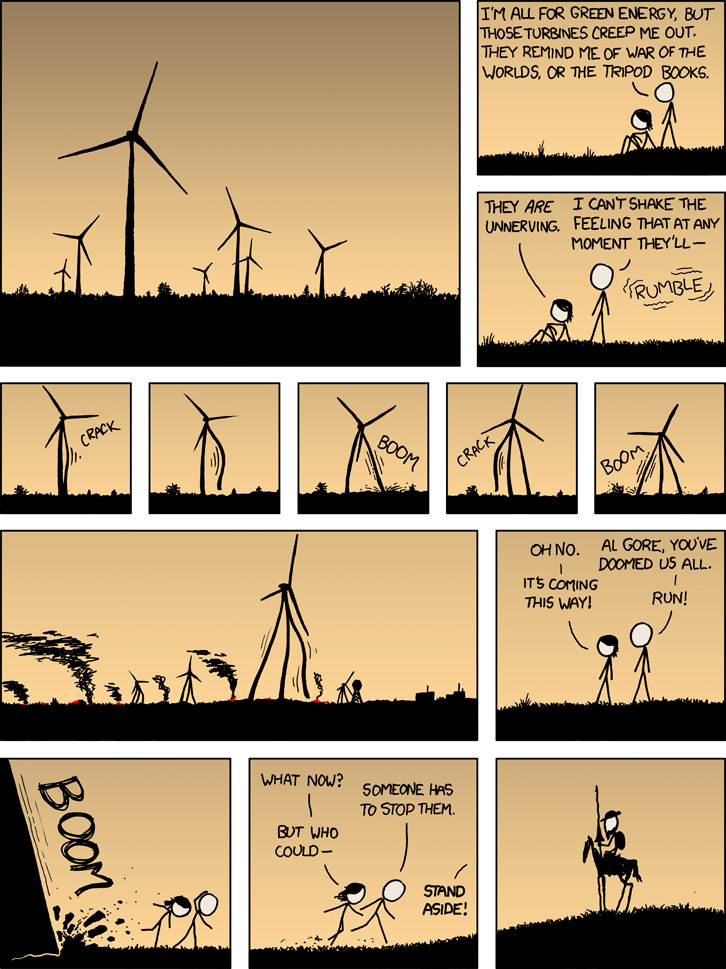
 Not only a perfect twist ending, but a gradual drawing out of the highly improbable and eventually the whimsical from the sheer mundanity of electricity generation.
Showing posts with label wonder. Show all posts
Showing posts with label wonder. Show all posts
Sunday, March 15, 2009
Every Blog Links xkcd Sooner or Later.
Courtesy of xkcd. Click on the picture, or just go to the website, because Blogger doesn't love big pictures.
Not only a perfect twist ending, but a gradual drawing out of the highly improbable and eventually the whimsical from the sheer mundanity of electricity generation.
Not only a perfect twist ending, but a gradual drawing out of the highly improbable and eventually the whimsical from the sheer mundanity of electricity generation.


Monday, March 9, 2009
Axis Monday: Castles in the Sky
Towers or spires are the most common manmade form of the axis mundi. However, in certain cases a castle or palace may take on the same characteristic.
Now it is obvious that certain castles or palaces--Versailles is the most apparent--hold some of the same traits as the axis mundi, just as the U.S. Capitol does today. But these are political axes mundorum. They do indeed represent the center of all things for a nation or culture, upon which all converges, but solely in that political sense. These structures, or similar ones, are also metonymous for the government itself (e.g. 'The White House today released a statement that..." and similar ubiquities).
But these two castles do not bridge the mundane and the symbolic in that particular way. These are more naturalistic axes. They form central poles less because of their history or importance than their position. Both are situated halfway between Earth and Sky.
Now it is obvious that certain castles or palaces--Versailles is the most apparent--hold some of the same traits as the axis mundi, just as the U.S. Capitol does today. But these are political axes mundorum. They do indeed represent the center of all things for a nation or culture, upon which all converges, but solely in that political sense. These structures, or similar ones, are also metonymous for the government itself (e.g. 'The White House today released a statement that..." and similar ubiquities).
But these two castles do not bridge the mundane and the symbolic in that particular way. These are more naturalistic axes. They form central poles less because of their history or importance than their position. Both are situated halfway between Earth and Sky.
Swallow's Nest
Swallow's Nest has no political importance. It is not particularly large (65 ft x 33 ft), nor particularly old (1911). But it is nevertheless spectacular. It is one of the most popular tourist attractions in the Crimea. And it forms a triple bridge between Earth, Sea, and Sky:

Much of Swallow's Nest's power comes from the continuity between cliff and castle. The natural rock transitions quite smoothly into the artificial stone. The castle appears to belong exactly where it is; indeed, it would be shocking if it wasn't there.
From a different angle:
 This photograph emphasizes sea and sky over stone. The sea forms a nearly perfect line with the bottom of Swallow's Nest, which emphasizes the castle's liminal standing at a junction of three worlds.
The small size of Swallow's Nest--despite its great stature--suggests that it is a conduit or a bridge between the world. But the next palace is not so humble. Quite simply, it reigns from on high.
Neuschwanstein

The archetypical fantasy castle on a far-off hillside is real, and rules over field and forest from a high peak in Bavaria.
The location of the castle speaks for itself but the castle holds other secrets which make its existence even more wondrous.

This photochrom of the castle dates from the 1890s, shortly after its completion. As the photos suggest, it stands upon a high pinnacle (like Swallow's Nest) and behind it lie endless misty mountains which give way only to sky. The first photo shows Neuschwanstein as a local axis; the second, however, presents it entirely within the realm of the sacred--the extremely romanticized print leaves out everything of humanity, except the castle itself. And the castle, though made by human hands, does not seem out of place.
The castle's background shows that I am not all smoke and mirrors:
-Ludwig II, King of Bavaria--also known as the Swan King, the Mad King, and the Fairy-tale King--commissioned the palace. He did so on behalf of Richard Wagner, to whom he wrote a letter about the castle:
Other points of note:
-No architect designed the castle. A theatrical set designer drew the plans. Wagner himself hired the man.
-Even today, no one may take photographs inside the castle. The only way to see what the inside looks is, quite simply, to go there.
-Ludwig did not live to see the castle completed. A doctor commissioned by the state declared him insane in 1886, and the king was arrested and dragged out of Neuschwanstein. Both the doctor and the king were found drowned not long after.
Neuschwanstein is, in short, straight out of mythology, and wrought from pure archetype.
But, although it is almost without question the most fabulous (i.e. out of fable) castle in the world, and holds great wondrous power, it is still just an axis. It is a product of human design, and it must pale always before the true natural sacred, the Holy Mountain, before which Neuschwanstein is next to nothing:

Swallow's Nest has no political importance. It is not particularly large (65 ft x 33 ft), nor particularly old (1911). But it is nevertheless spectacular. It is one of the most popular tourist attractions in the Crimea. And it forms a triple bridge between Earth, Sea, and Sky:

Much of Swallow's Nest's power comes from the continuity between cliff and castle. The natural rock transitions quite smoothly into the artificial stone. The castle appears to belong exactly where it is; indeed, it would be shocking if it wasn't there.
From a different angle:
 This photograph emphasizes sea and sky over stone. The sea forms a nearly perfect line with the bottom of Swallow's Nest, which emphasizes the castle's liminal standing at a junction of three worlds.
The small size of Swallow's Nest--despite its great stature--suggests that it is a conduit or a bridge between the world. But the next palace is not so humble. Quite simply, it reigns from on high.
Neuschwanstein

The archetypical fantasy castle on a far-off hillside is real, and rules over field and forest from a high peak in Bavaria.
The location of the castle speaks for itself but the castle holds other secrets which make its existence even more wondrous.

This photochrom of the castle dates from the 1890s, shortly after its completion. As the photos suggest, it stands upon a high pinnacle (like Swallow's Nest) and behind it lie endless misty mountains which give way only to sky. The first photo shows Neuschwanstein as a local axis; the second, however, presents it entirely within the realm of the sacred--the extremely romanticized print leaves out everything of humanity, except the castle itself. And the castle, though made by human hands, does not seem out of place.
The castle's background shows that I am not all smoke and mirrors:
-Ludwig II, King of Bavaria--also known as the Swan King, the Mad King, and the Fairy-tale King--commissioned the palace. He did so on behalf of Richard Wagner, to whom he wrote a letter about the castle:
"It is my intention to rebuild the old castle ruin at Hohenschwangau near the Pollat Gorge in the authentic style of the old German knights' castles... the location is the most beautiful one could find, holy and unapproachable, a worthy temple for the divine friend who has brought salvation and true blessing to the world."Neuschwanstein--named for the palace of Wagner's Swan Knight, Lohengrin--is thus not an axis because it provides a conduit or link between the worlds, but because the castle is itself a sacred object, made manifest in our world. The hierophany, the revelation of the sacred, appeared to Ludwig, and he revealed the already extant spiritual power of the mountaintop.
Other points of note:
-No architect designed the castle. A theatrical set designer drew the plans. Wagner himself hired the man.
-Even today, no one may take photographs inside the castle. The only way to see what the inside looks is, quite simply, to go there.
-Ludwig did not live to see the castle completed. A doctor commissioned by the state declared him insane in 1886, and the king was arrested and dragged out of Neuschwanstein. Both the doctor and the king were found drowned not long after.
Neuschwanstein is, in short, straight out of mythology, and wrought from pure archetype.
But, although it is almost without question the most fabulous (i.e. out of fable) castle in the world, and holds great wondrous power, it is still just an axis. It is a product of human design, and it must pale always before the true natural sacred, the Holy Mountain, before which Neuschwanstein is next to nothing:

Tuesday, February 3, 2009
Cows with Names Produce More Milk
A new study by the Newcastle University School of Agriculture shows that cows whose farmers name them and call them by their names regularly produce 500 more pints of milk a year than cows without names.
Farmers in the study found the results unsurprising; one said that treating cows as individuals was "vitally important."
Farmers emphasized that the cows are part of their families and each one has her own personality.
It now appears that, like us, cows want to be recognized not as cogs in a machine, but as individual beings. It makes them happy and more productive.
Somehow, this story awakens my sense of wonder at the world more than almost any other I have posted.
Farmers in the study found the results unsurprising; one said that treating cows as individuals was "vitally important."
Farmers emphasized that the cows are part of their families and each one has her own personality.
It now appears that, like us, cows want to be recognized not as cogs in a machine, but as individual beings. It makes them happy and more productive.
Somehow, this story awakens my sense of wonder at the world more than almost any other I have posted.
Wednesday, January 14, 2009
Eclectic Ephemera I
New Feature!
I've had portions of this list for several weeks now (hence the outdated Christmas links) when I still thought of calling this feature 'A Hodgepodge of Ballyhoos'. But that is too whimsical and this blaag is about wonder before whimsy (although whimsy certainly has its place... I daresay I personally rank it third among feelings, after wonder and nostalgia)
But nevertheless this feature shall consist of little titbits of intriguing know-how from the Internet or elsewhere, things that don't quite merit a lengthier discussion but which nevertheless are striking. Take a gander:
[The idea for this feature is definitely NOT cribbed from the excellent and more cleverly named “Instantiations of Nift” on Scott Siskind's blog. Of course not.]
Originally this feature was slated to appear on Sundays, which is more fitting considering basic Abrahamic mysticism and hermetic philosophy. Numerology based on this original intent dictates that there shall be seven items per week.
 Bonus: A traditional Sami storehouse in northern Finland. I am absolutely certain that the frightful image of Baba Yaga's house, with its walking chicken legs, came from Russians who headed too far into the northern, liminal forests and saw some of these frighters.
1.A (somewhat lacking) history of the letter g. Even I couldn't tell you why our most fundamental but least penetrating symbols change like this over time. The vagaries of endless history, I suppose. Perhaps the Greeks couldn't quite remember how that Sidonian scribble looked... and since then it's been all about creative typography, I suppose. Here is a great article on the same subject from a Freemasonic perspective.
2.In other circumstances I'd call it nationalism, but Nova Roma transcends such base urges. The entire micronation is solely based on nostalgia. This is wonder in its most clear and basic sense. But it's still weird (For the record, SCA is not nostalgic. It is wistful).
3.“Why did the chicken cross the road” may be the first joke most children learn. They hear it and repeat it, never realizing that it is the most common of all postmodern, intertextual jokes. The joke, like all jokes, defies expectations—but by turning a humorous setup into a mundane result. By nature it disappoints. By nature it isn't funny. And by nature it doesn't make sense unless you already understand the idea of a joke, and the sorts of jokes this one references. Hence the deep irony that it is the first joke children learn. They assume it's funny, because they know that it is a "joke." But it isn't, that's the point, and this is utterly lost on them.
4.Literary plurals for animals have a long history (They are called 'terms of venery,' to be proper).
Birds have the best. Parliament of owls, murder of crows. Thus writers turn something so mundane as a couple of pigeons hanging out into the charming and expressive. Very fey. You can see a great list here. Here's some other good ones:
a. A piteousness of doves, an exalting of larks, a pandemonium of parrots, an ostentation of peacocks, an unkindness of ravens (Hey Schuyler, look at that unkindness flying overhead!), a kaleidoscope of butterflies, a fever of stingrays. Some of these may be spurious, but who cares?
While we're on the subject, I formally propose that a bunch of giraffes are not a herd; they are a hullaballoo. This word perfectly fits their nature.
5. At this week's SAG meeting, which ultimately dragged out for over thirty hours, a lengthy discussion broke out over whether they should extend the prescribed meeting length by three hours.
The discussion to extend the meeting by three hours lasted eight hours.
I find this much more hilarious and whimsical than they did.
6. This one's a bit more on the 'creepy' side. A woman's husband recently died. She buried his cellphone with him and still calls him regularly just to chat. In fact, she had his number inscribed on the stone. She also still covers the bill.
7. According to the Wall Street Journal, the United States strongly considered bailing out Christmas. After all, Santa Claus is 'too big to fail'. Proof that even the stodgiest, most matter-of-fact paper in the country still has time now and then for the marvelous. Witness also that NORAD, one of America's most powerful military organizations, manages to find time each year to track Santa Claus for the sake of children's happiness.
Cheers,
Pseudo-Hermes
Sunday, January 4, 2009
A Whimsy On Magic
 What comes to mind when the word “magic” is heard? Merlin putting the sword in the stone? Harry Potter waving his wand? David Blaine tricking stupid people into thinking he can levitate? Magic, noun-the art of producing a desired effect or result through the use of incantation, gesture, or other means. When we hear “magic” we think of the seemingly supernatural effects we are incapable of, not the seemingly supernatural effects we deal with on a day-to-day basis. Magic is alive and well and integrated into our everyday lives.
A young man has met with an elusive old hermit on the streets of London. This hermit, a bearded and disheveled beggar, is supposedly going to train him in the arts of the occult. He says to the hermit, “teach me some magic.” The hermit asks for a fiver. The young man rolls his eyes and gives him a five-pound note, which the hermit uses to buy fish and chips. The now-angry young man exclaims “Aren’t you supposed to be teaching me something?” to which the hermit, contentedly munching on his fish and chips, replies, “I just traded a piece of paper for vital sustenance. How is that not magic?”
But, you say, currency has an agreed-upon value. There’s nothing magic about that. Wrong. That is the very definition of magic. Magic is evoking physical actions from people via shared belief using seemingly inert materials. There are actual cases of people being condemned to death by local priests/witch-doctors/shamans and subsequently dying. Much in the same way that the communal belief in the power of a curse can kill someone, it is our communal belief in the strength of our economy that helps make it strong. Why should I provide you vital sustenance for that piece of paper? Because I know I can trade it to someone else. Alright, I'll accept that, but why should I put my pieces of paper in the local bank? At any given time a bank owns, at most, 10% of its assets in hard currency. It is the belief in the strength of the bank that allows it to exist, if we didn’t believe our money was safe we would withdraw it en masse only to find it wasn’t there (which happened during the Great Depression).

Not only this, but the physical presence of these pieces of paper has a nigh-supernatural effect have on our behavior. I think to Abbie Hoffman’s infamous 1973 prank of scattering hundreds of dollar bills on the floor of the New York Stock Exchange. These wizards of finance, many of whom so wealthy they could bathe in such bills and set fire to them every day of the remainder of their lives, trampled one another to grab them. Trading was shut down, and visitors were not allowed into the NYSE again until a glass barrier had been installed.
And that is not the only form of magic that we encounter on a daily basis. Performance, too, is itself a form of magic. Think back to our earlier archetypes, Merlin and Harry Potter using their robes, incantations, and wand gesturings to effect change. Is this not precisely what a performer does? Performers put on their magic garments (costumes/uniforms), intone the magic words (sing poetry, speak rhetoric), and gesture appropriately with their magic wands (props, musical instruments) to effect enormous change within their audiences.

Think to the last concert you attended where the band managed to get the audience jumping and screaming. Think of the historical orators who could take ordinary docile men and women and whip them into a lynch mob or an army capable of conquering Europe. Think to the godlike power of theater* and its extension/enhancement, film, in its ability to evoke involuntary spasmic breathing (laughter) or involuntary tear-duct malfunction (people can be made to feel empathy for images on a screen!)
By moving and speaking the performer brings about a seemingly magical change in another. No, we cannot hit someone with an enormous blast of psychic power by putting our hands together and screaming “KAMEHAMEHA” (though this would be hilarious to witness in an actual fight), but most societies have at some point through oratory and nationalist rhetoric persuaded their citizens to needlessly endanger their lives by charging into battle against opponents they have no quarrel with to enrich a handful of people they will never meet. Which sounds more absurd to you?
*-a theme explored in plays as early as The Bacchae. The connection is made explicitly in The Tempest, where the magic of Prospero (seen below) is directly linked to the magic of the stage.


Sunday, December 14, 2008
BANANA
Behold the wild banana:
 The wild banana belongs on Axis Monday for a very simple reason: it is wondrous!
Rather, the wild banana tastes and looks really gross. But it is wondrous that man has wrought the spirit of nature into a form so much more suitable for him. Without icky seeds.
 The wild banana belongs on Axis Monday for a very simple reason: it is wondrous!
Rather, the wild banana tastes and looks really gross. But it is wondrous that man has wrought the spirit of nature into a form so much more suitable for him. Without icky seeds.
Subscribe to:
Posts (Atom)